
Industrial Resilience Estimator
Impact Analysis
The short answer is that we can survive, but we might not thrive. While the US has managed to grow its GDP by focusing on high-value services, the lack of a robust industrial core creates a dangerous dependency. When you outsource the physical act of creation, you don't just outsource labor; you outsource the knowledge of how things work. This 'innovation gap' is where the real danger lies.
The Great Shift to Services
To understand where we are, we have to look at how the US economy is a diversified system where the service sector now accounts for roughly 80% of GDP. This includes everything from healthcare and finance to software development and legal services. On paper, this looks like a win. We traded low-wage factory jobs for high-paying roles in Silicon Valley and Wall Street. Why build a million t-shirts when you can design the software that manages the entire logistics chain for a billion t-shirts?
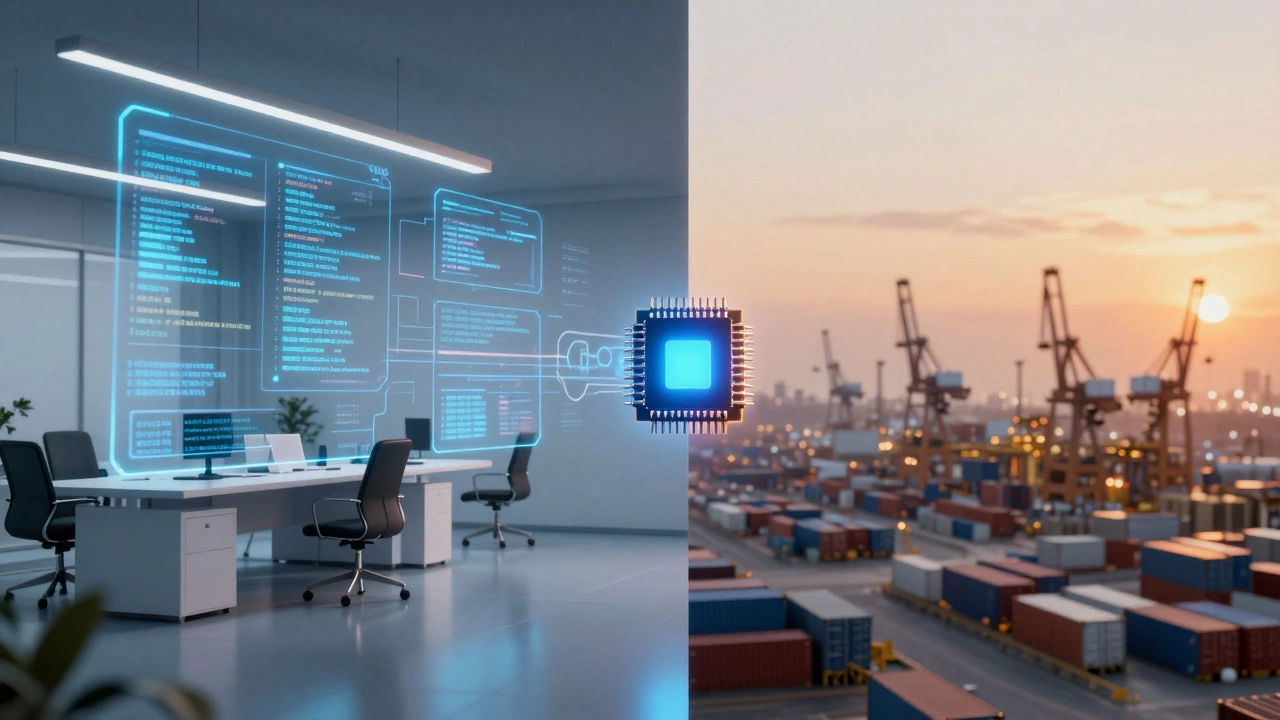
But here is the catch: services aren't a closed loop. You can't have a digital economy if you don't have the hardware to run it. The semiconductor industry is the perfect example. For years, the US designed the most advanced chips in the world, but the actual fabrication happened mostly in Taiwan. When a pandemic or a political spat hits, the 'service economy' suddenly realizes it can't actually function without a physical product to lean on. That's not a sustainable strategy; it's a gamble.
The Hidden Cost of Deindustrialization
When a town loses its main factory, it doesn't just lose jobs; it loses a specific kind of cognitive infrastructure. Manufacturing is where the "rubber meets the road" for innovation. If you design a product in a vacuum without being close to the people building it, you miss the subtle iterations that make a product better, cheaper, or more durable. This is why China didn't just become the world's factory; they became a powerhouse in engineering by iterating on the shop floor.
We've seen this play out in the automotive sector. The US still has massive plants, but the shift toward Electric Vehicles (EVs) has exposed how much we've lagged in battery chemistry and raw material processing. We have the software and the branding, but the physical supply chain for lithium and cobalt is largely controlled by others. If the US wants to lead in the next industrial revolution, it can't just be the 'idea guy'; it has to be the builder too.
Can Government Intervention Save the Day?
For a long time, the prevailing wisdom was that the government should stay out of the way and let the "invisible hand" of the market decide where things are built. But the market cares about the lowest cost today, not national security tomorrow. Now, we're seeing a massive pivot toward Industrial Policy, where the government actively steers the economy using subsidies and tax breaks.
| Policy / Act | Primary Goal | Key Target Sector | Economic Mechanism |
|---|---|---|---|
| CHIPS and Science Act | Reduce reliance on foreign chips | Semiconductors | Direct grants and tax credits |
| Inflation Reduction Act | Green energy transition | EV Batteries, Solar | Consumer and producer tax credits |
| Infrastructure Investment and Jobs Act | Modernize logistics | Steel, Concrete, Transit | Public spending on projects |
These aren't just random spending sprees. They are attempts to create "clusters" of expertise. By funding a semiconductor fab in Arizona or a battery plant in Georgia, the government is trying to rebuild the ecosystem of suppliers, technicians, and engineers that disappeared in the 1990s. This is called reshoring-bringing production back home to ensure that the US isn't left stranded during the next global crisis.
The New Era: Advanced Manufacturing
Let's be clear: we are never going back to the 1950s. We aren't going to bring back the millions of low-skill assembly line jobs because the math doesn't work. Labor is too expensive in the US compared to Southeast Asia. However, the goal isn't "more jobs," but "smarter jobs." This is where Advanced Manufacturing comes in.
Advanced manufacturing uses Automation, 3D printing (additive manufacturing), and AI-driven robotics to make production efficient enough to compete with low-wage countries. If a robot can do the work of ten people for a fraction of the cost, the "cheap labor" advantage of overseas factories disappears. The US can succeed without a *massive* labor force in manufacturing, but it cannot succeed without a *massive* capacity for high-tech production.
Take the aerospace industry as an example. The US continues to dominate because it integrates cutting-edge software with precision engineering. The production isn't about sheer volume; it's about extreme complexity. This is the blueprint for the rest of the economy: focus on the things that are too hard or too critical to leave to someone else.
The Risks of the 'Service Only' Path
If the US doubles down on being a service-only economy, it faces three primary risks. First is the Vulnerability Risk. We've already seen how a single blockage in the Suez Canal or a factory shutdown in Shanghai can cause prices to spike in Ohio. Reliance on a "just-in-time" global supply chain is essentially an invitation for instability.
Second is the Social Risk. A service economy creates a "barbell" distribution of wealth. You have a huge number of high-earning professionals (doctors, coders, bankers) and a huge number of low-earning service workers (retail, hospitality, delivery). Manufacturing historically provided the "middle"-decent-paying jobs for people without university degrees. Without a manufacturing base, the middle class continues to shrink, leading to political and social unrest.
Third is the Innovation Risk. As mentioned, the loop between design and production is vital. When the person designing the chip doesn't talk to the person etching the silicon, the pace of improvement slows down. By hollowing out the industrial base, the US risks losing its edge in the very technologies it claims to lead.
The Path Forward: Strategic Autonomy
The goal for the next decade isn't total self-sufficiency-that's impossible and economically foolish. Instead, the US is moving toward "strategic autonomy." This means identifying a handful of critical sectors where the country cannot afford to be dependent on others. These include semiconductors, active pharmaceutical ingredients (APIs), and critical minerals for batteries.
This requires a shift in how we view the economy. We need to stop seeing manufacturing as a "dirty" industry and start seeing it as a high-tech endeavor. Education must pivot toward vocational training and "mechatronics," blending mechanical engineering with electronics and software. If we can create a workforce that knows how to operate and maintain a fleet of AI-driven robots, we solve the labor cost problem and the security problem at the same time.
Why can't the US just import everything and focus on software?
While it's profitable in the short term, relying solely on imports creates extreme vulnerability. Global conflicts or pandemics can cut off supplies of essential goods, from medicine to microchips. Furthermore, you lose the engineering expertise that comes from actually building products, which eventually slows down innovation in software and design.
Will reshoring bring back the old factory jobs?
Not in the way they existed in the 1960s. Most new factories are highly automated. We won't see millions of unskilled assembly line roles, but we will see a demand for technicians, robot operators, and industrial engineers. The jobs will be fewer in number but higher in skill and pay.
Does the government actually have the power to influence where companies build?
Yes, through industrial policy. By offering billions in tax credits and grants-like those in the CHIPS Act-the government can make it financially viable for companies to build in the US even when labor costs are higher. It's essentially paying companies to prioritize national security over the absolute lowest cost.
What is the difference between a service economy and a manufacturing economy?
A service economy generates value through intangible products: expertise, software, financial management, and healthcare. A manufacturing economy generates value by transforming raw materials into physical goods. A healthy modern economy needs a balance of both to ensure stability and growth.
Isn't automation just a way to replace workers?
Automation replaces specific tasks, not necessarily entire jobs. While it reduces the need for manual labor, it creates a need for people who can design, program, and fix the machines. The challenge is transitioning the workforce from manual labor to technical oversight.
Next Steps for a Stronger Economy
If you're a business owner or a policymaker, the focus should be on building "resilient clusters." Don't just build one factory; build an ecosystem of small suppliers around it. For students, the smartest move isn't necessarily a degree in pure computer science, but a hybrid skill set-something like robotics or industrial AI. The future belongs to those who can bridge the gap between a line of code and a physical piece of hardware. That is how the US economy doesn't just survive, but leads again.